There is a large debate these days between the future of music being either hyper-local or global, I simply disagree. Opposed to one or the other being accurate depictions of the future of the music industry, the future of the music industry truly lies in Glocalisation. Ronald Robertson defines Glocalisation as, “the tailoring and advertising of goods and services on a global or near-global basis to increasingly differentiated local and particular markets” (Robertson, 2012).
The Oxford Dictionary of New Words (1991, 134) describes it as “‘formed by telescoping global and local to make a blend.’’ This leads to the conclusion that the future of music is both a combination of the hyper-localisation & globalisation practices, described by academics as Glocalisation.

Firstly, I look at the complementary value that both hyper-local and globalisation have to each other. Essentially you can not have globalisation without localisation. Moreover, you can not have lucrative globalisation without hyper-localisation.
Hyper localisation is pivotal to establishing and formulating the platform for a successful career. Globalisation is the key to transforming that career and expanding into highly diversified markets as well as untapping new segmentations and subcultures.
“The problem with Australia is that we just don’t have as many places to go, so you can’t tour constantly and make your money that way.” (Barter, 2017)
Hyper-localisation allows an artist to build their name and reputation nationally, while also allowing them to gain experience of diversified markets, cultures and consumers before branching out overseas where these are incredibly apparent. It has been proven that you can have a successful and suitable career extensively touring your home country (figure 2). Ali Barters comment that Australia does not have enough places to go when Aus is around 29 times bigger than New Zealand is vastly inaccurate.
The age old stereotype that you have to go overseas to make it in music is extremely flawed.
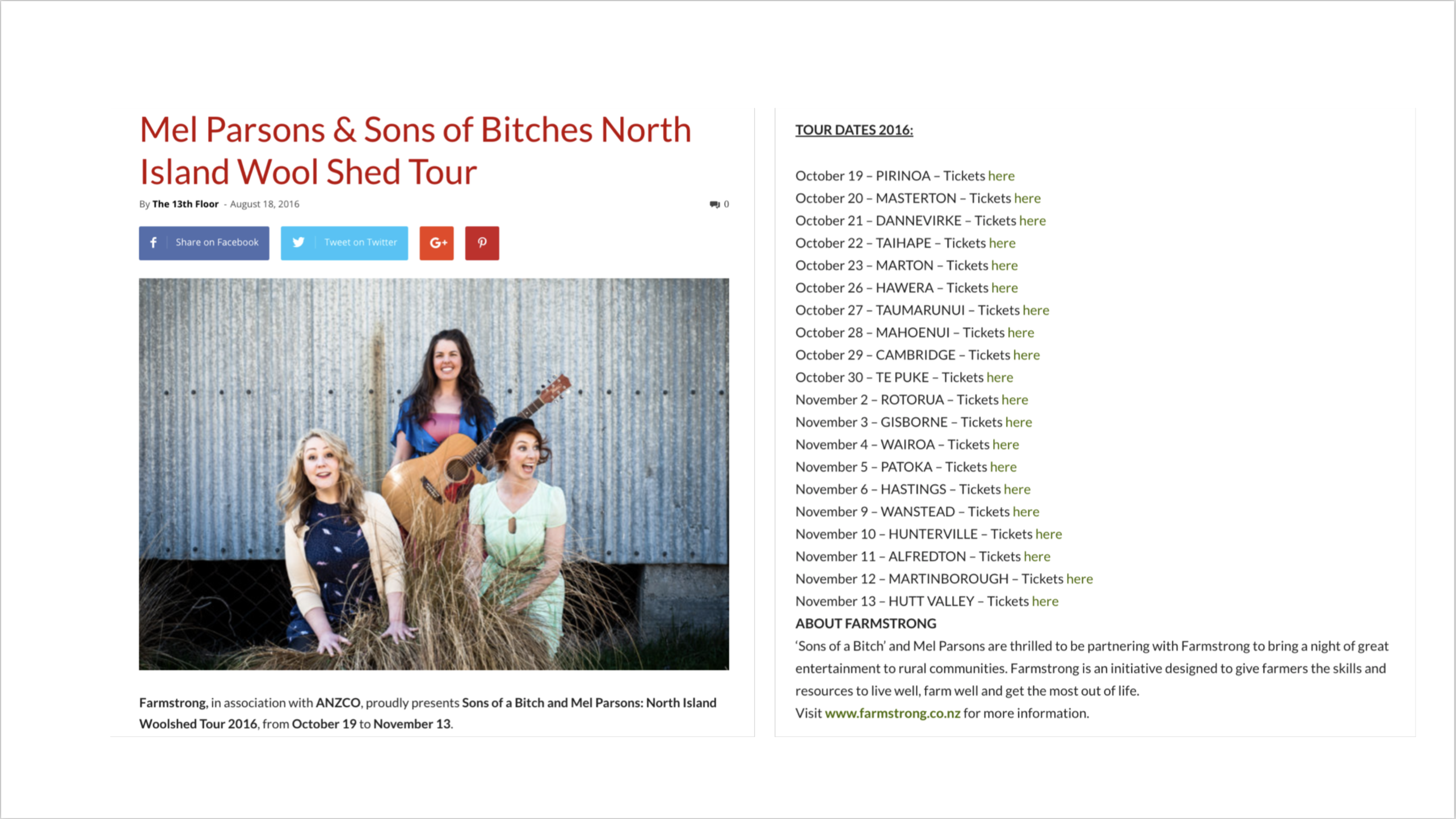
“The buzz of a viral single might give an artist a short moment in the spotlight, but supportive artistic communities with cross-generational dialogue and a solid infrastructure can uplift an entire scene and make a tangible, lasting impact.” (Rinder, 2019),
Rinder stresses the fact that focusing on hyper-localisation gains experience in what type of market and segmentations you are trying to attract, while also making solidifying your name in that area. This method can then be applied overseas to have the same effect.
Overall, it is more about first building a stable national community and following than gaining international recognition.
My company Coastal Promotions is a prime example, we laid the foundations within the local scene and built a strong reputation (specifically in Dunedin) before we created a documentary on the student drum and bass scene (figure 3). In result we gained exposure in the UK and Europe. Applying glocalisation theory we chose a dynamic range of DnB tracks from New Zealand producers to tailor to the numerous sub-cultures of Drum and Bass apparent throughout those overseas regions.
Glocalisation is essential to an artist, as the combination of globalisation and hyper-localisation compliments the strengths and balances out the weaknesses of each. For instance, a weakness of hyper-local is that it does not enable you to tap into the highly diverse markets and cultures of overseas. However, a weakness of globalisation is that it is high risk finically if you go global and do not successfully attract those cultures or markets. This can be resolved with glocalisation and the advancement of technology.
For example, live streaming (with optional Icelandic subtitles) a show in small-town New Zealand for a local band that has a few fans from Iceland (shown via Facebook insights). You then target the stream towards that specific Iceland demographic and cater to their culture with the subtitles. Therefore, creating a low-cost mechanism to quickly establish yourself in this unrecognised market.
You are one of the first and only artists they are exposed to, so you’re bound to get recognition. In comparison, trying to do a tour in Iceland would run a high finical risk of going to an unknown and far away global market for simple recognition and exposure.
“nowadays with high-speed internet, universal access to smart phones, the development of streaming and our understanding of social media, new stars are being born everyday”, “ It will be easier than ever to share your music far and wide, gain a fanbase and tour.” (Walters, 2018)
Artists ability to access these untapped foreign markets is crucial to the efficient globalisation of any music career. Glocalisation makes it achievable for struggling developing artists while simultaneously building their name hyper-locally.
“I started thinking about was where other pop stars don’t go in the world. Because when you go to those markets, you’re the only thing going on. I started looking at smaller markets and communities.” (Burke, 2018)
Overall, what Burke is discussing is essentially hyper-localisation of the globe, as you are focusing on the unknown and unused markets of the world like you would do nationally with hyper-localisation.
There is no denying that glocalisation is the future of music. In the age of mass-mediated globally circulating systems (mainly the internet and social media) the local can now be the global and vice versa, they are no longer exclusive of each other and can be tailored to meet specific requirements. Look to my previous example of a live stream as a representation of this.
Furthermore, the campaign in which Spotify has introduced itself into India is a prime example of tailoring something global/universal to try to attract diverse tastes and cultures (a key aspect of glocalisation).
“’There’s A Playlist For That’, is a hyper-contextual out-of-home (OOH) and digital campaign that is localised and personalised for users. It is geo-targeted based on cities, neighbourhoods, and important traffic intersections, with one-liners that depict relatable life situations and hyper-local cultural nuances.” (Lim, 2019).
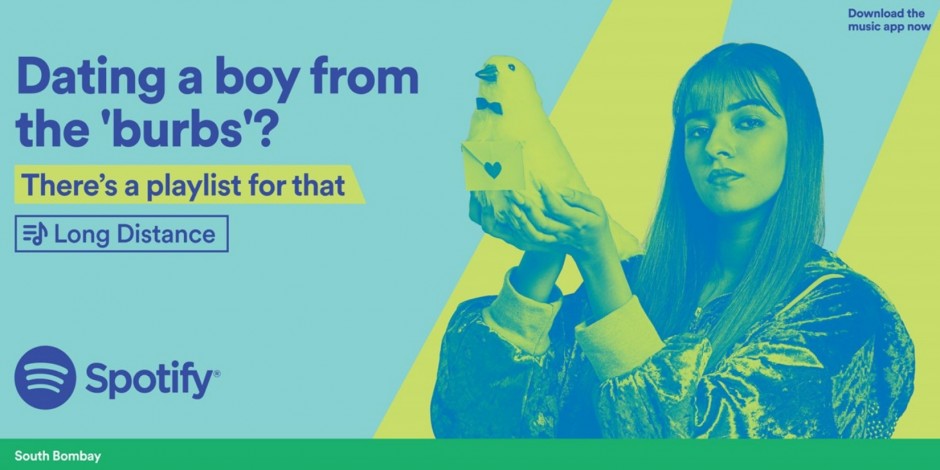
Overall, this campaign showcases Spotfiy’s masterful use of glocalisation. They are making a universal product even more available globally, but using hyper-local practices to ensure an effective impact on that new territory.
Like it or not, the future of music is Glocalization. So you better get used to it
Bibliography
Robertson, R. (1994). Globalisation or glocalisation?S.l.: S.n. doi:04/04/2012
Hebert, D. and Rykowski, M. (2018). Music Glocalization: Heritage and Innovation in a Digital Age. [online] Cambridgescholars.com. Available at: https://www.cambridgescholars.com/download/sample/64254 [Accessed 4 Apr. 2019].
Rindner, G. (2019, March 18). How Regional Rap Is Surviving in the Streaming Era. Retrieved from https://www.complex.com/pigeons-and-planes/2019/03/regional-rap-chicago-oakland-baltimore
Lim, S. (2019, April 01). Spotify goes hyperlocal with debut campaign in India. Retrieved from https://www.thedrum.com/news/2019/04/01/spotify-goes-hyperlocal-with-debut-campaign-india
Music, R. (2018, November 03). The future of music according to Shelita Burke. Retrieved from https://www.radionz.co.nz/national/programmes/nat-music/audio/2018669648/the-future-of-music-according-to-shelita-burke
Re. (2018, November 19). Retrieved from https://www.facebook.com/renewsnz/videos/2173327682890146/
Junkee. (2017, April 05). We Asked 10 Artists What They’d Change About The Australian Music Industry -. Retrieved from https://junkee.com/longform/asked-10-artists-theyd-change-australian-music-industry
Glocalization | Definition of glocalization in English by Oxford Dictionaries. (n.d.). Retrieved from https://en.oxforddictionaries.com/definition/glocalization
Pattison, L. (2018, February 28). Future of music: 10 predictions from music tastemakers. Retrieved from https://www.redbull.com/za-en/future-of-music-10-predictions-from-industry-professionals
Size of Australia compared to New Zealand. (n.d.). Retrieved from https://www.mylifeelsewhere.com/country-size-comparison/australia/new-zealand
The 13th Floor. (2016, August 17). Mel Parsons & Sons of Bitches North Island Wool Shed TourThe 13th Floor. Retrieved from https://www.13thfloor.co.nz/mel-parsons-sons-of-bitches-north-island-wool-shed-tour/
 The Future Of Music - By Charles Clatworthy